
Find Bankruptcy Records in Evanston
Bankruptcy records for Evanston residents are held at the U.S. Bankruptcy Court for the Northern District of Illinois, Eastern Division. Evanston sits in Cook County, just north of Chicago along the lakefront. All bankruptcy cases from the city go to the federal courthouse at 219 S. Dearborn Street in Chicago. The court keeps every petition, schedule, motion, and order on file. You can search these records through PACER online or visit the clerk's office in person during regular business hours.
Evanston Quick Facts
Bankruptcy Court Serving Evanston
Evanston does not have a federal courthouse. There is no bankruptcy court in the city. All filings go to the Northern District courthouse in downtown Chicago. The drive from Evanston to the Dirksen Federal Building takes about 30 minutes without traffic, though rush hour can stretch that out quite a bit. The CTA Purple Line runs from Evanston into the Loop, which makes getting to court possible without a car.
| Court | U.S. Bankruptcy Court, Northern District of Illinois |
|---|---|
| Address | 219 S. Dearborn Street Chicago, IL 60604 |
| Phone | (312) 408-5000 |
| Hours | Monday through Friday, 8:30 AM to 4:30 PM |
| Website | ilnb.uscourts.gov |
Security at the Dirksen Building requires a photo ID. Cell phones are allowed. The clerk's office is inside the building and handles public records requests for Evanston bankruptcy cases and every other case in the district. Staff there can help you look up a case number, check a docket, or get copies of filed documents. They close at 4:30 PM, so plan ahead.
How to Search Evanston Bankruptcy Records
Start with PACER. The PACER Case Locator lets you search by a person's name or a business name. It covers every federal court in the country. Set up a free account. Most searches cost ten cents per page. If your charges stay below $30 in a quarter, you owe nothing. PACER is the fastest way to find bankruptcy records from Evanston without leaving your home.
The Northern District runs its own CM/ECF system. This is where attorneys file documents electronically. The public can access case information through CM/ECF with a PACER login. It has the most current data. New filings show up here before they appear anywhere else. You can view the docket, read motions, check orders, and see whether a case is still open or closed.
The court location page shows the Chicago office details for Evanston filers.
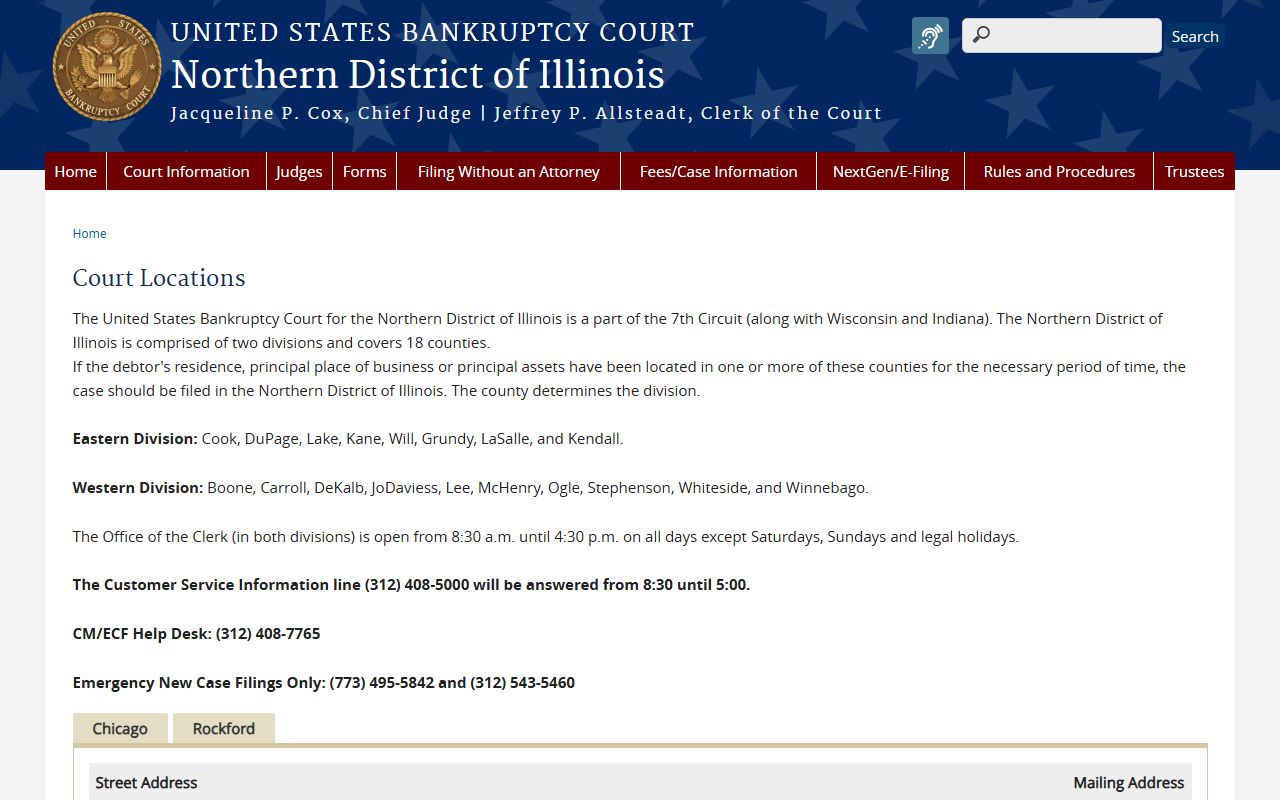
That page lists the building address, phone number, and hours. It also notes which judges sit in the Eastern Division, which is the division that covers Evanston cases.
If you want to search in person, the public access terminals at the courthouse let you look up cases for free. No PACER account needed for the terminals. Just bring your ID and head to the clerk's office.
Filing for Bankruptcy in Evanston
Under 28 U.S.C. § 1408, you file for bankruptcy where you have lived for the greater part of the last 180 days. If Evanston has been your home for at least 91 of those days, you file at the Northern District, Eastern Division. This is the same court that handles Chicago cases.
The filing fee for Chapter 7 is $338. Chapter 13 costs $313. Chapter 11 is $1,738. You can ask the court to let you pay in installments. For Chapter 7, some people qualify for a full fee waiver based on income. The court looks at whether you can afford any part of the fee before granting a waiver.
Before you file, you must complete credit counseling from an approved provider. That is a hard rule under 11 U.S.C. No exceptions. The counseling can be done online, by phone, or in person. After you finish, you get a certificate that goes with your petition. You also need a second course in financial management before you can get your discharge. These steps apply to every Evanston filer.
The petition itself is a big set of forms. You list every debt you owe, every asset you own, your income for the last six months, and your monthly expenses. Mistakes on these forms cause delays. A lot of Evanston residents use an attorney. But the court has a self-representation page if you want to file on your own. It explains the required forms and the local rules for the Northern District.
What Happens After Filing
Once you file, the automatic stay kicks in. This is one of the most important parts of bankruptcy. Under 11 U.S.C., the stay stops creditors from collecting. No more calls. Lawsuits pause. Wage garnishments stop. Foreclosures halt, at least for a while. The stay starts the moment the court receives your petition.
A trustee gets assigned to your case. For Chapter 7, the trustee looks at your assets to see if anything can be sold to pay creditors. Most Chapter 7 cases in the Northern District are "no asset" cases, which means the trustee finds nothing to distribute. The 341 meeting of creditors takes place about 30 to 40 days after filing. You answer questions under oath. Creditors can show up, but most do not. Chapter 7 cases from Evanston usually close within three to four months after the 341 meeting.
Chapter 13 works differently. You propose a repayment plan that lasts three to five years. The trustee collects your payments and distributes them to creditors. You keep your property, but you must stick to the plan. Missing payments can get your case dismissed.
Cook County Circuit Court and Related Records
Bankruptcy is strictly federal. But the Cook County Circuit Clerk at 50 W. Washington, Suite 1001, Chicago (phone: 312-603-5030) handles state court matters that often connect to bankruptcy. Debt collection lawsuits, foreclosure filings, and judgment liens are all state court cases. If you have any of those pending when you file for bankruptcy, the federal case affects the state case.
The automatic stay stops state court collection actions. But the records still exist in both systems. After a discharge, you may need to file paperwork in Cook County to release a lien or close out a state court case. Evanston residents sometimes have to deal with both courts to fully wrap things up. Knowing where to look in each system helps.
Federal Jurisdiction Over Evanston Cases
Under 28 U.S.C. § 1334, the federal district court has original and exclusive jurisdiction over bankruptcy cases. No state court can hear one. The bankruptcy court is a unit of the district court. Judges handle cases by referral from the Northern District. This has been the setup since Congress created the modern bankruptcy system.
The Bankruptcy Code at 11 U.S.C. sets the rules. Illinois offers its own set of property exemptions that Evanston filers can use. You can also pick the federal exemptions if they protect more of what you own. The homestead exemption, wildcard exemption, and retirement account protections all matter. Which set is better depends on your situation. A lawyer can run the numbers, or you can compare the lists yourself using resources from the Northern District court site.
Legal Help for Evanston Residents
Evanston has good access to legal resources. Northwestern University's Pritzker School of Law is right in the city. Their clinical programs sometimes handle bankruptcy matters for qualifying clients. Legal Aid Chicago also serves Cook County residents who meet income guidelines. They can help with bankruptcy questions and may take cases directly.
The Evanston-North Shore area has many private bankruptcy attorneys as well. Initial consultations are often free or low cost. The Illinois Courts website lists self-help resources for people going through the process without a lawyer. The Northern District clerk's office cannot give legal advice, but they will let you know if your forms are missing something or if you need to fix a filing. Between court resources and local legal aid, Evanston residents have options.
Cook County Bankruptcy Records
Evanston is part of Cook County. All bankruptcy filings for Evanston residents go through the federal court system, but the Cook County Circuit Court handles related civil matters like debt collection suits and foreclosures. For more on county-level court records and resources, visit the full county page.
Nearby Cities
Several cities near Evanston are also in Cook County and use the same federal court for bankruptcy filings. These neighboring cities all fall under the Northern District, Eastern Division.